Available filters Toggle display
- Category
- Price
Publications
Need to be tax-exempt?
Contact Laura Tharnish before ordering.
ltharnish2@unl.edu or 402-472-1576
-
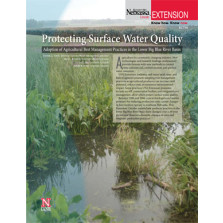
Protecting Surface Water Quality
$2.00Between 1996 and 2006, farmers in the Big Blue River Basin in southeast Nebraska adopted a number of best management practices to help increase yield, reduce costs, and minimize environmental impacts. This Extension Circular documents the dramatic changes over this 10-year period in corn and sorghum operations related to tillage, irrigation, fertilization, water conservation, pest management practices, and cropping systems. Research and data from grower surveys is well illustrated with graphics, maps, photos, and tables.
Learn More -

-
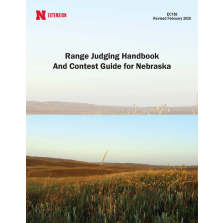
Range Judging Handbook and Contests
$5.00Learn MoreThis 70-page handbook helps youth learn basic principles of range ecology, including soil-plant and plant-animal interactions, and plant successions. In addition to the topics listed below, it also includes a glossary, sample range judging cards, and a number of related tables to aid in judging. Main chapter topics include
- Range plant identification and classification
- Rangelands and plant community change
- Range sites
- Range condition
- Proper use
- Wildlife habitat management
- Managing rangeland resources
- Range management text questions
- Contest guide for range judging
-
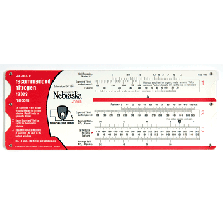
Recommended Nitrogen Rates for Corn Slide Rule
$1.00Corn farmers looking for a quick and easy way to calculate their nitrogen rate or consider adjustments based on nitrogen and corn costs will appreciate this handy, pocket slide rule. To use this tool, you will need to know the amount of soil organic matter in your fields based on soil tests.
The Corn Nitrogen Rate Slide Rule was produced with financial support from the Nebraska Corn Board.
Learn More -
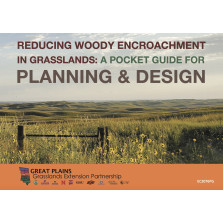
Reducing Woody Encroachment in Grasslands: A Pocket Guide for Planning & Design
$1.32The pocket guide for reducing woody encroachment is a field-based resource created to support training and extend principles from the original Vulnerability Guide (Reducing Woody Encroachment in Grasslands: A Guide for Understanding Risk and Vulnerability). The pocket guide is designed to fit in your pocket (5 x 7”) to use as a field reference for planning and design. Learn More -
Skillful Grazing Management on Semiarid Rangelands
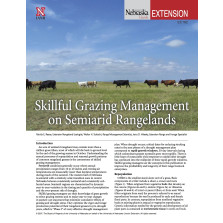
$1.00Understanding the annual processes of repopulation and seasonal growth patterns of common rangeland grasses is the cornerstone of skilled grazing management and long-term ranching success. This publication describes grazing forages reproduction, the growth patterns of plant parts, and grazing management, including under drought conditions. It includes photos and illustrations of the seasonal distribution of plant growth for common rangeland grasses. Photos are used to illustrate root growth and habit of leading Nebraska grasses Learn More -
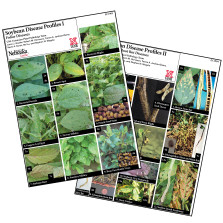
Soybean Disease Profiles
$2.00This pair of publications covers various diseases that can affect soybeans and the management of those diseases.
Soybean Disease Profiles I, EC1903 contains descriptions and photos of foliar diseases of soybean with brief management suggestions. Diseases included are bacterial blight; bacterial pustule; brown spot; purple seed stain; downy mildew; frogeye leaf spot; soybean rust; powdery mildew; and bean pod mottle virus.
Soybean Disease Profiles II, EC1904 contains descriptions and photos of stem and root rot diseases of soybean with brief management suggestions. Diseases included are brown stem rot; charcoal rot; fusarium wilt and root rot; phytophthora root and stem rot; pod and stem blight; phomopsis seed decay; seedling blight; rhizoctonia root rot; sclerotinia stem rot; soybean cyst nematode; stem canker; and sudden death syndrome.
Learn More -
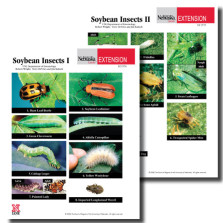
Soybean Insects Photo Identification Guides
$2.00This set of two photo identification guides covers the major insect pests of Nebraska soybean. Soybean Insects I (EC1574) covers bean leaf beetles, soybean leafminers, green cloverworms, alfalfa caterpillars, cabbage looper/soybean loopers; yellow woollybears, painted ladies, and imported longhorned weevils. Soybean Insects II (EC1575) covers Deetes stem borer, soybean thrips, whiteflies, soybean aphid, potato leafhopper, twospotted spider mite, green stink bug, brown stink bug. Learn More -
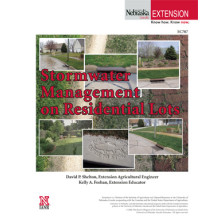
Stormwater Management on Residential Lots
$2.50When water from rain or melting snow can’t soak into the ground, it flows over lawns, structures, pavement, and bare soil, collecting contaminants and soil particles which are carried to local lakes and rivers. This publication looks at how stormwater runoff develops and describes basic low-cost, low-maintenance steps that landowners can take to reduce unintended pollution. 8 pages. Learn More -
Stormwater Management: Terminology
$1.00Not available online
Stormwater runoff occurs when precipitation does not infiltrate soil, but instead, flows over land or through storm drains to streams, rivers, and lakes. This water collects pollutants as it moves over streets, parking lots, driveways, and other surfaces. To reduce pollution, it’s important to manage this stormwater runoff at the home, city, state, and national levels. This 12-page Extension Circular presents commonly used terms in stormwater management practices, strategies, and regulations. Learn More